Quebec, in Other Words.
The Project
Create a playful and interactive journey inside an exhibition to show how Quebec’s society and population have evolved over time.
- Integrate the interactive stations so they become an integral part of the exhibition’s narrative.
- Make interactions simple and engaging to maintain visitor attention.
- Design the visual look of screens and interfaces.
- Support technical planning with the development team.
- Run workshops with the exhibition team to ensure alignment and shared direction.
- Create a memorable final experience that impresses visitors and stays with them.
A Historic Exhibition
Sharing the evolution of Quebec society isn’t just about presenting history: it’s about creating a dialogue between the past, present, and future. For its new flagship exhibition, the Musée de la civilisation du Québec wanted to go beyond presenting artifacts. The goal was to invite the public to recognize themselves within the collective story and to engage visitors actively.
The museum approached this challenge with the ambition to transform a museum visit into a participatory, accessible, and playful experience.
A Cultural Vision, Not Just a Technological One
In museums, it’s tempting to add screens and call it innovation. But here, the starting point was different: interactivity had to serve meaning — not replace it.
How do you translate a cultural vision into a digital experience?
How do you ensure that each interactive station amplifies the message rather than distracting from it?
How do you help all visitors — children, families, casual visitors, tourists — understand and feel Quebec’s collective journey?
The questions weren’t technical. They were about identity.

Multiple Stakeholders, One Story
Scenographers, curators, researchers, technicians, designers, managers, developers… plus several external suppliers.
More than a dozen stakeholders for a single exhibition. Each with expertise. Each with a vision. Each with a personal definition of the project — and of success.
In this context, the key challenge was alignment. Creating an experience that would unify the whole exhibition. Turning rich — and sometimes divergent — intentions into a clear and coherent visitor journey. Simplifying the exhibition design while supporting the largest digital deployment ever undertaken by the MCQ.
Dream, Simplify, Make It Tangible
Behind every interactive station lies a choice: to guide, surprise, enlighten, or question.
Here’s what we did:
- Script interaction flows
- Synchronize art direction with the overall exhibition
- Co-plan technical aspects with the museum team
- Test quickly and iteratively to validate what words alone cannot explain
- Ensure accessibility and inclusivity across all installations
In short, we created a guiding thread that leads the visitor through the entire journey.

Connecting Content and Technology
Designing an interactive exhibition requires navigating between two worlds: creativity and technology.
We needed to orchestrate both:
- Integrating interactivity into the scenography itself, not as an add-on
- Ensuring visitor progression toward a meaningful climax
- Honoring and gamifying the essence of the CLESSN research project (a partner research chair)
A balance between data, culture, and the visitor experience.

A Finale That Leaves a Mark
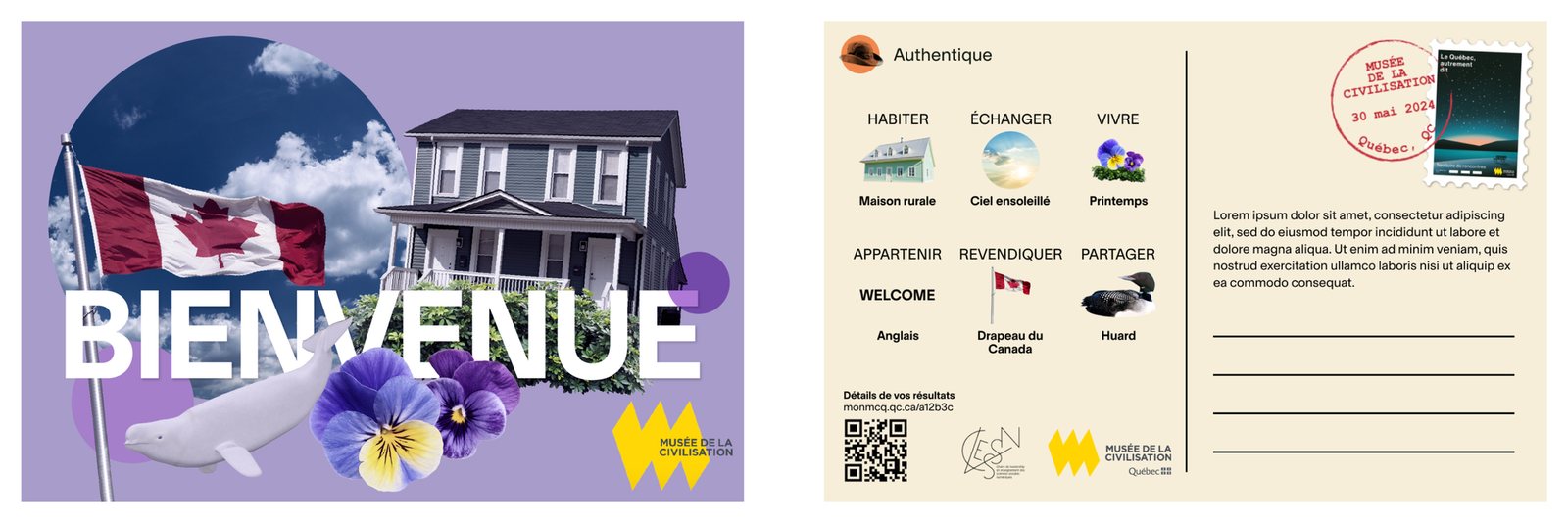
The final experience appears in each section of the exhibition, inviting visitors to share their opinions and perceptions about Quebec society. As a progression mechanic, a personalized postcard representing each visitor is created throughout the experience. Yes — we drew inspiration from the IKEA effect: creating something increases engagement.
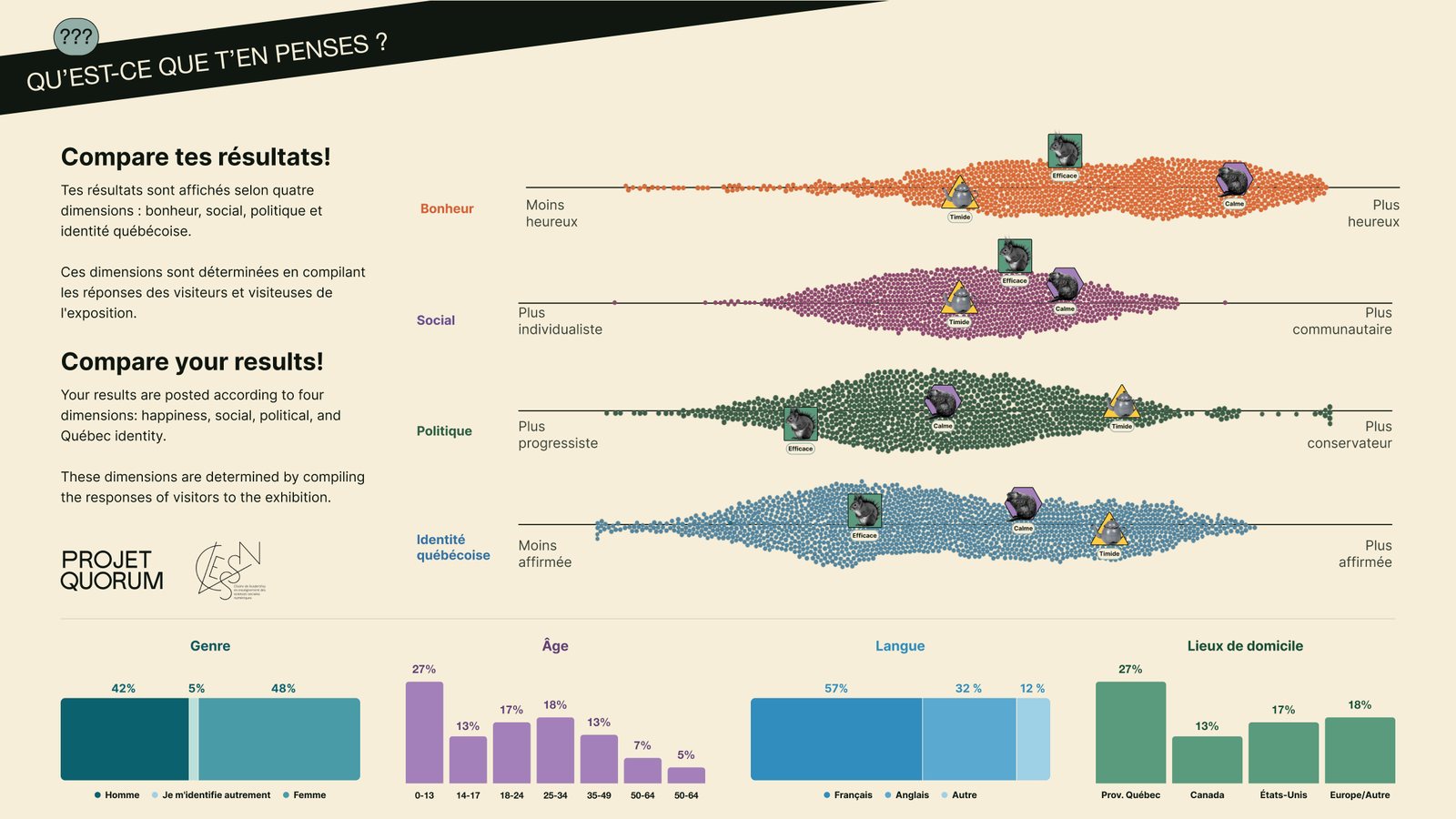
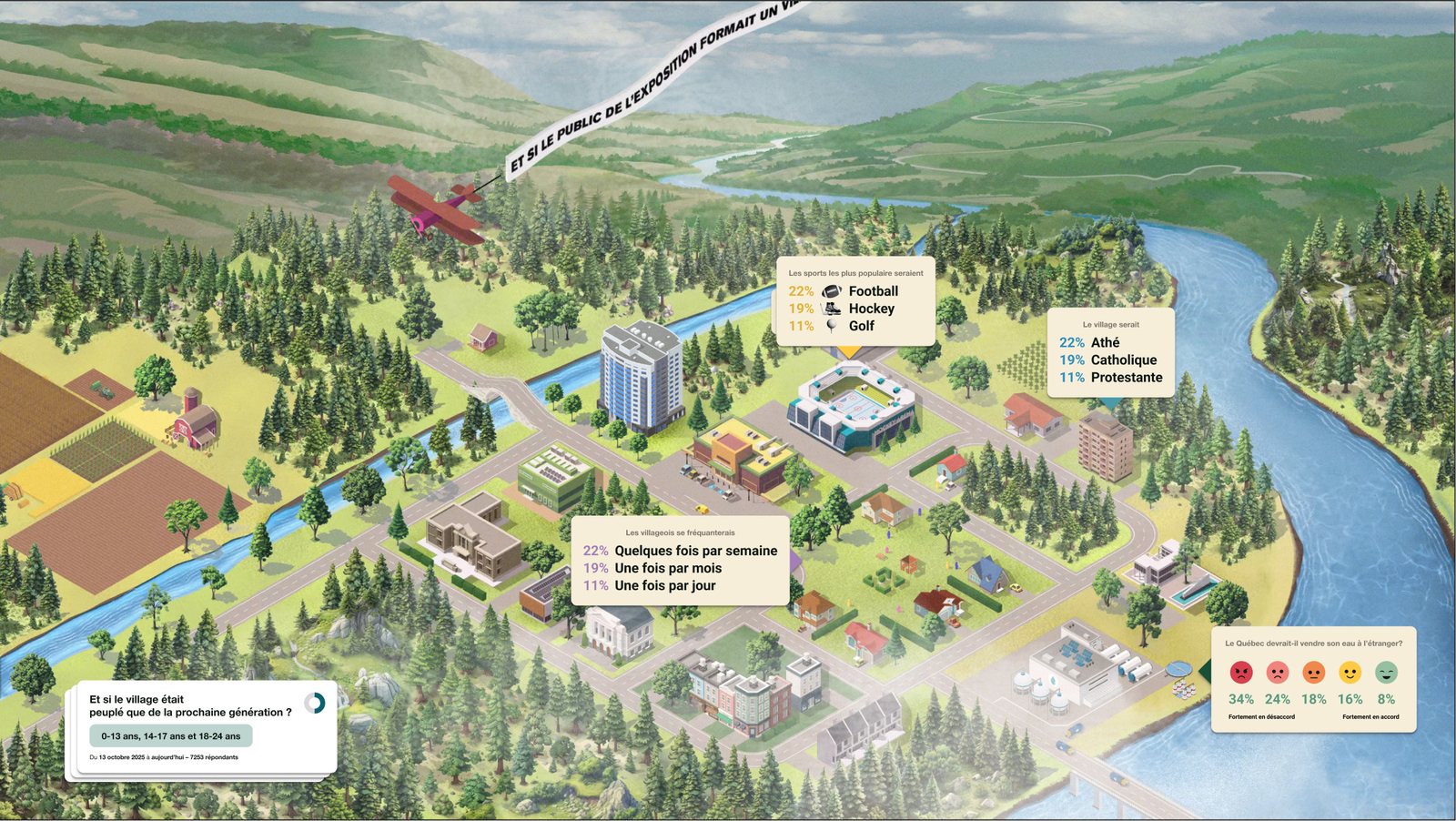
The journey ends with a signature moment: a two-part space where visitors can see all the responses collected from everyone, as well as a small Quebec village representing visitors that evolves over time — week after week!
It was a pleasure to contribute to one of the MCQ’s most ambitious and complex exhibitions, which received the 2025 Numix Award – Social Impact Mention.
Congratulations to everyone who contributed.
And to all visitors who — by participating — helped shape the experience!
The kiosks, up close
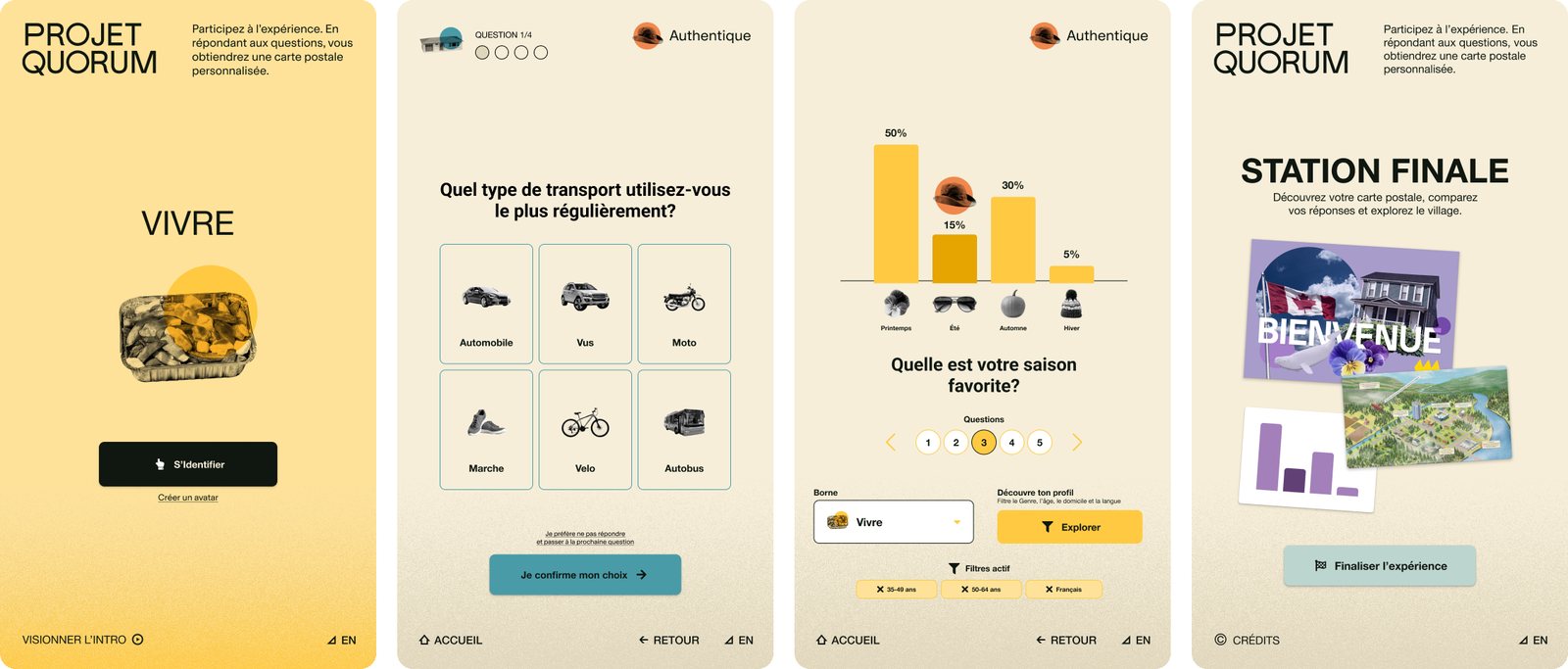
The kiosks are called Quorum. Visitors build a profile, answer the questions of each pavilion, see how they compare with everyone else, and leave with a digital postcard shaped by their own answers. Every kiosk is built from the same small parts, one design system, so the museum team can keep adding questions for years without redesigning anything.
Today
Le Québec, autrement dit has been the Musée de la civilisation’s reference exhibition since May 2024. The kiosk questions are meant to keep running for 10 to 15 years, and the village keeps changing long after opening night. In 2025, the exhibition received the Social Impact mention at the Prix Numix.
Coverage, in French: the museum’s press release, Université Laval on the Quorum project, Radio-Canada, La Presse, Le Devoir and the Prix Numix 2025.
The team. Creative direction: Jean-Sébastien Daigle, &friends. Art direction, web and graphic design: Stéphanie Lavoie, Sens du style. Data visualization: Eliot Jacquin. Survey design and data analysis: CLESSN. Village design and animation: Simon Giguère. Project management and programming: Musée de la civilisation.